
Fields in Douglas County Property Tax Records
Douglas County splits the numbers between two offices. The Douglas County Appraisal Department supplies valuation and assessment facts, and the Tax Commissioner handles billing and collection. One PIN ties their records to each other. Check the year beside every figure, since a current assessment, an earlier payment, and a delinquent balance can all sit in the same file.
| Field | What it shows | Official source |
|---|---|---|
| Current and previous value | Values exposed for the stated tax year | Appraisal, QPublic, and GIS |
| Assessed value | The taxable fraction before applicable exemptions and millage | Appraisal record |
| Exemption indicator | Homestead or special-use status requiring its current definition | Appraisal and Tax Commissioner |
| Bill and due date | Final levy, due date, balance, and receipt trail | Tax Commissioner |
| Delinquency or Fi.Fa | Past-due tax and lien or levy information | Delinquent list and sale notice |
Georgia generally assesses taxable property at 40 percent of fair market value, subject to statutory exceptions and current-use programs. Exemptions come off before millage is applied. The result is a tax figure, not a sale appraisal.
Douglas Appraisal Sets Value, Tax Commissioner Collects
Georgia's Department of Revenue describes the county role split plainly. Assessors set fair market and assessed values. The Tax Commissioner bills, collects, and carries property tax information, payments, change-of-address forms, delinquency, sales, and excess funds. Douglas Appraisal reviews exemptions and receives appeals. Appraisers may inspect, measure, or photograph property under O.C.G.A. §48-5-264.1. County guidance says they use badges and marked vehicles. A field visit supports valuation work, not collection. The official Douglas County Appraisal page publishes the current assessment-notice and appeal route.
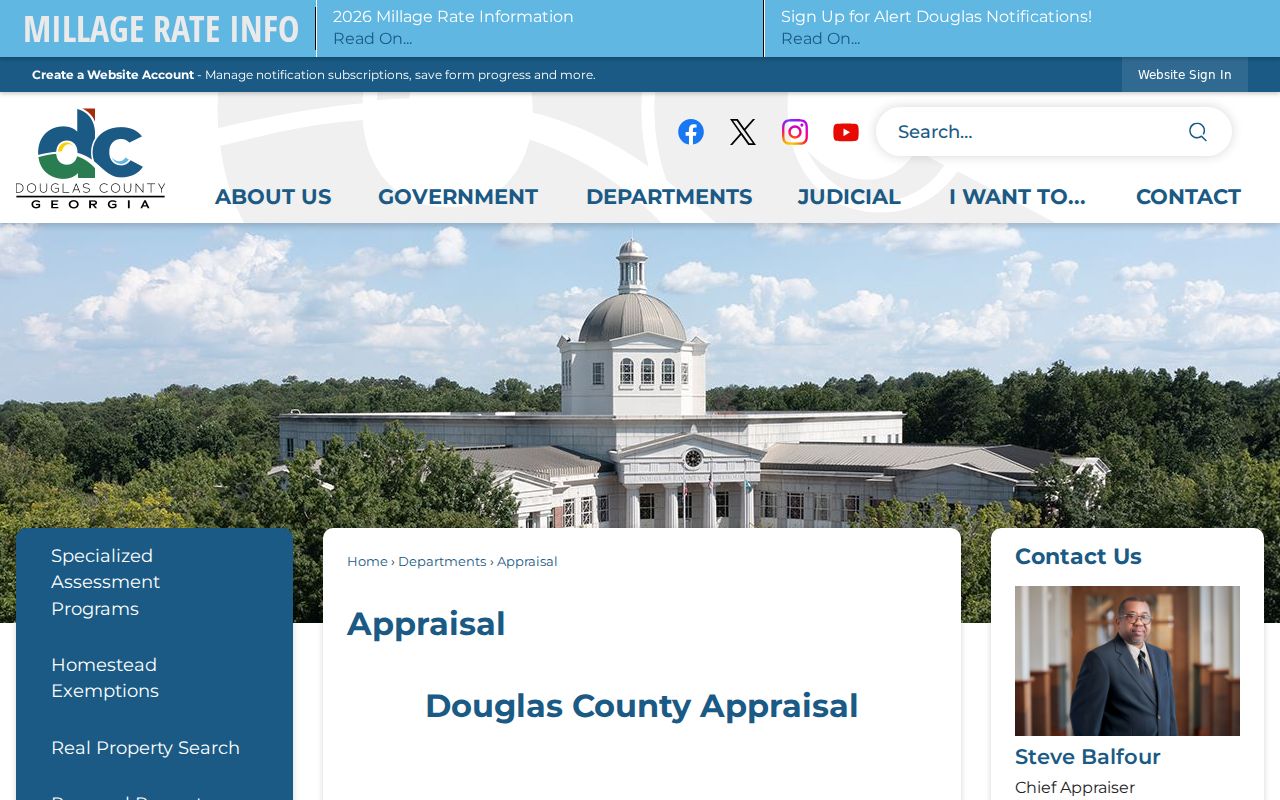
Notice dates, deadlines, and filing steps shift each cycle.
Note: Direct a value dispute to Appraisal and a payment or balance question to the Tax Commissioner to avoid needless rerouting.
Douglas County Uses Georgia's 40 Percent Rule
The Georgia DOR valuation guide states the standard rule: assessed value equals 40 percent of fair market value under O.C.G.A. §48-5-7. Special-use programs can follow different statutory treatment. Douglas parcel services also display previous value, current value, value-change date, home-exemption status, sale price, and acreage. Each figure carries its own tax year.
- Fair market value
- The assessor's estimate under Georgia law, not a promised sale price.
- Assessed value
- The taxable fraction, generally 40 percent of fair market value.
- Millage
- The levy rate applied to net assessed value.
- Homestead exemption
- Approved tax treatment for an eligible primary residence.
- Tax lien or Fi.Fa
- An enforcement claim tied to unpaid taxes.
The January 1 Name on Douglas Property Tax Records
The tax bill follows the January 1 owner of record. That is the name the Tax Commissioner uses when mailing each year's bill. A parcel can sell later in the year. The former owner's name can still appear on that bill, even after a newer deed reaches the county's deed records. Returned-mail notices make this easy to see. They list the Parcel ID, the parcel address, the January 1 owner, and the last known mailing address together.
Taxes during a transfer year are handled between buyer and seller. For a clear picture of current title, pull the newest deed from the Clerk of Court or through GSCCCA. Do not rely on the tax roll name. Douglas County publishes no fixed schedule for how quickly a recorded deed updates the roll.
Look Up a Douglas County Tax Bill
The Tax Commissioner links a property and payment interface. Prior-year coverage varies by parcel. Start with the PIN, then confirm the year, situs address, taxpayer name, due date, base tax, fees, payments, and balance.
- Open the official Tax Commissioner page and follow its property-information or payment link.
- Search with the PIN when possible. If using an address, confirm the legal and situs details.
- Verify the tax year before comparing values, bills, or payments.
- Read assessment, exemption, millage, billed amount, due date, receipt, and delinquency as separate entries.
The Government Window interface is a county-linked third-party route. Tax Commissioner FAQs describe a 3 percent online convenience fee, partial payments, and receipt access. Check the amount before you pay.
Douglas Homestead and CUVA Signals
The homestead information page lays out local routes, while Georgia DOR frames the state rules. A HOME_EXEMPT or coded field is only a lead. It cannot tell you who occupies the property. Read the current definition and approval status. The online application asks for property and prior addresses, voter-registration and vehicle or utility details, ownership facts, and uploads. Conservation Use Value Assessment carries its own covenant and eligibility rules, and such programs can push taxable and market-like figures apart.
Note: An exemption code affects tax treatment and should not be used as proof of residence, identity, or market value.
Douglas County Fi.Fa and Delinquent Tax Trail
The current delinquent list publishes PARID, owner, prior year, situs, and total amount. The Tax Commissioner explains the enforcement path. An unpaid account can lead to a Fi.Fa tax lien, levy, and tax sale. A listed name marks only the record holder. It is no promise of marketable title. The 2026 notice set June 2, continuing June 3 if needed, at 6200 Fairburn Road. Its table joined parcel number, record holder, Fi.Fa defendant, amount due, tax years, deed book, and legal description, with buyer costs kept separate under the sale rules. That row can bridge delinquency to the GIS parcel. It also points you toward the Clerk deed book behind the Fi.Fa. Sale rules stress caveat emptor. The official Douglas County delinquent-tax list hosts the live public table rather than a static summary.
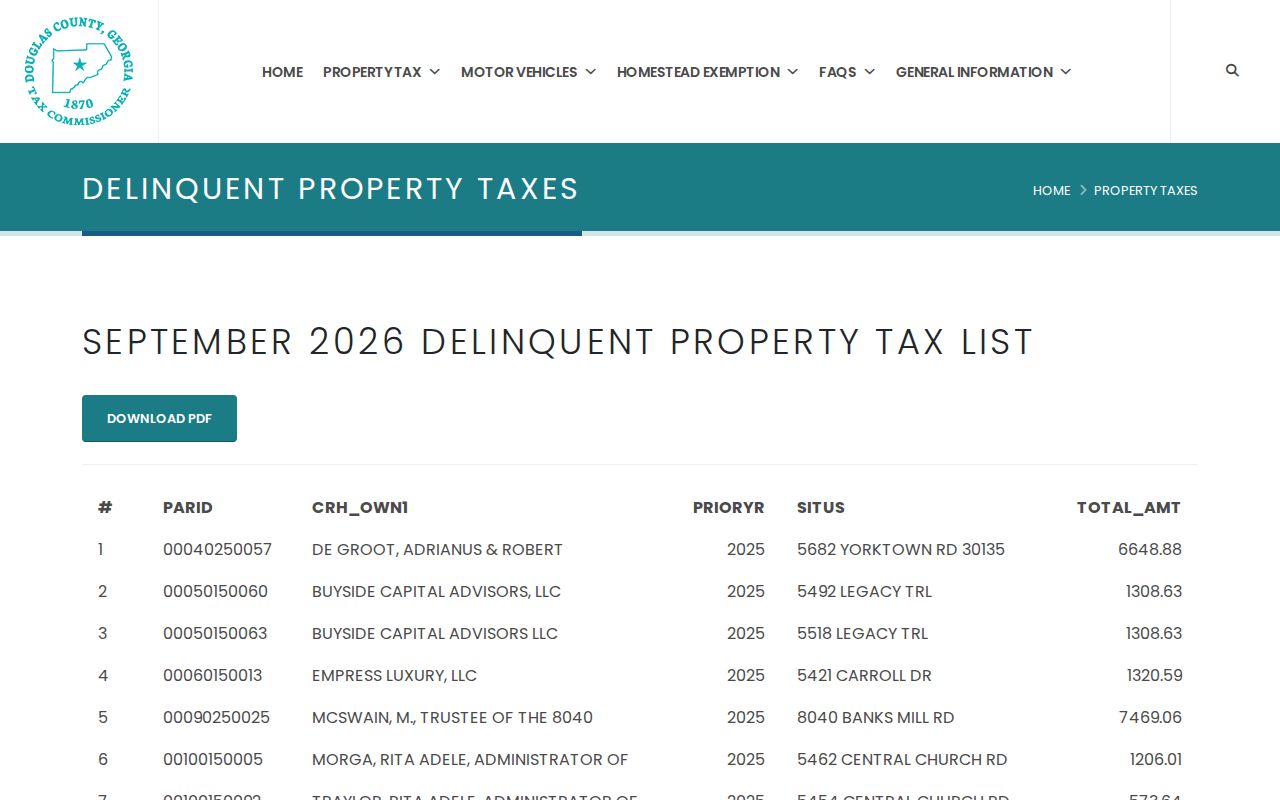
Recheck the live entry by PARID and tax year. Payment, withdrawal, or later enforcement can change a posted balance or sale status.
Read the Douglas Property Tax Sale Notice
The official Douglas County tax-sale page shows the sale procedure and published record fields.
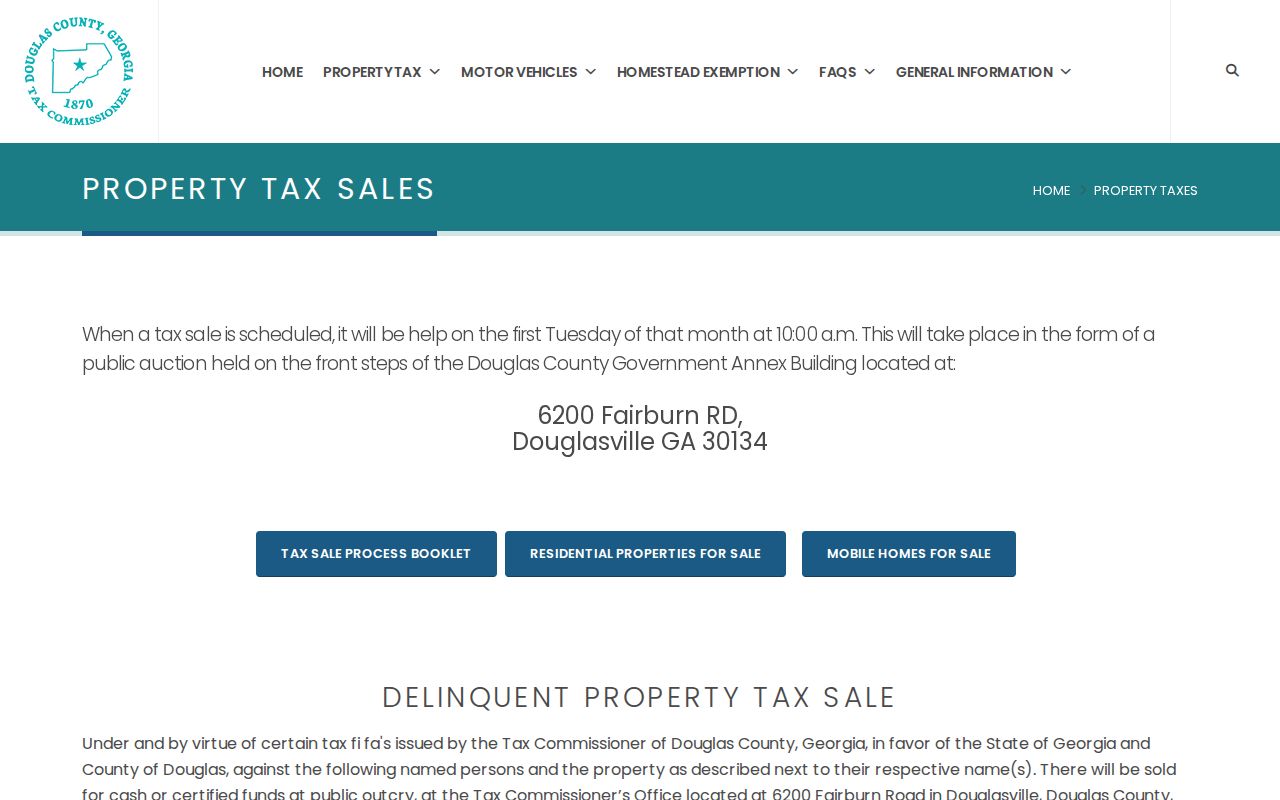
The notice works as an index into delinquency, deed, and parcel records. It settles no title, redemption, occupancy, boundary, or condition question.
Read Douglas Assessment Fields in Their Tax Year
Douglas County parcel services expose a set of coded fields: PREV_VAL, CURR_VAL, VALCHGDATE, HOME_EXEMPT, TOTAL_ACRES, SALEPRICE, DEED_DATE, and DEED_REASON. The Property Information service adds actual-value and assessed-value labels. Read together, the codes show that a value changed and when the database marked it. They also flag exemption codes and deed reasons. They never explain the cause by themselves.
Before reading values as a story, verify the PIN, situs address, legal description, acreage, and tax year. Then compare prior and current value without assuming a sale caused the gap. New construction can move the number. So can a parcel split, a combination, a corrected characteristic, an annual review, or an exemption change. A sale-price entry is a transfer clue. It does not certify an arms-length transaction.
Assessment notices precede the final levy. Douglas guidance says bills are mailed in early autumn and come due 60 days after mailing, with each bill stating its exact deadline. The notice carries value and estimated-tax context, while the final bill reflects county, Board of Education, and applicable city millage decisions.
Douglas Property Tax Payments and Address Changes
Tax Commissioner FAQs cover online, mail, and office payments, current and prior-year records, partial payments, and receipts. Online payment carries a convenience charge. The third party sets it at 3 percent. A receipt proves the shown transaction was accepted. It does not prove that every other tax year, parcel, lien, or later adjustment is clear.
The change-of-address request is the official route. Douglas County records keep a parcel's physical address separate from the taxpayer mailing address. Returned mail can explain a missing notice. A mismatch alone is not evidence of fraud, and it never changes the situs.
Save each bill or receipt. Label it with the tax year and PIN. Then record base tax, deadline, payment date, fees, balance, and any Fi.Fa or sale reference separately. One year's paid status does not carry over.
Excess funds form another record. They appear after a tax sale, when money remains after the tax debt and sale costs are applied. The Tax Commissioner publishes an excess-funds route for that money. A listed name can point back to the sale parcel and former record holder. Eligibility to claim is a separate legal question. Similar names are not the same interest. Match the sale date, parcel number, deed book, and legal description first.
Also preserve the tax years in the Fi.Fa, the amount due on the notice date, and any later payment or withdrawal. A published sale list can change before the auction. The county's delinquency and sale pages are dated snapshots, so recheck the official source and the Clerk's recorded trail before purchase diligence.
Contest a Douglas County Property Assessment
Douglas Appraisal mailed 2026 annual assessment notices on June 16, 2026, with appeals due July 31, 2026 at 11:59 p.m. Three filing routes existed. An appeal could be mailed, delivered in person, or filed online through the property search. Fax and email were not accepted. A representative needed an authorization letter.
For evidence, compare the parcel identity, land data, exemption status, current and prior values, sale facts, and valid comparable properties. Keep a dated copy of the notice and evidence. Appraisal lists 770-920-7228, mail at 8700 Hospital Drive, and an in-person appeal site at 6200 Fairburn Road, second floor.
Appeal windows are fixed. The stated 2026 deadline has passed. Use the active year's notice for its exact deadline and accepted filing methods.
Payment during an appeal stays at 85 percent. County guidance says that rate holds while an appeal is unresolved, subject to later adjustment, and the Douglas County property value guide explains the value labels without rebuilding the tax bill.